
 zakaz@net-server.com.ua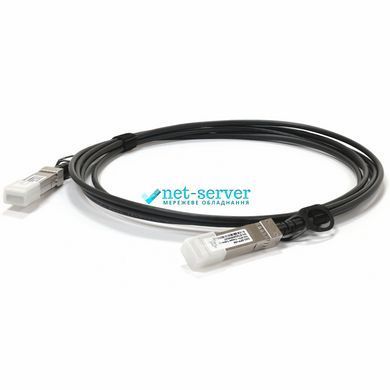



|
Quantity
|
Out of stock
|
||
|
|
|||
|
|
|||
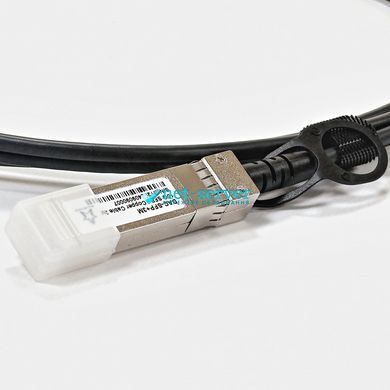
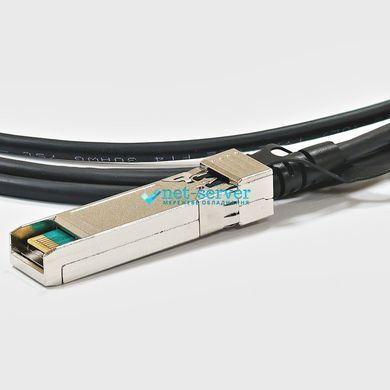
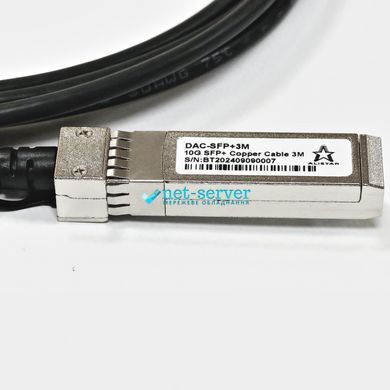
SFP+ DAC 10G Direct Attach Copper Twinax Cable for Direct Equipment Connection, 3 m
The SFP+ DAC 10G Direct Attach Copper (Twinax) Cable is designed for high-speed direct connections between networking devices with data rates of up to 10 Gbps. Equipped with two integrated SFP+ connectors, the cable provides a reliable and cost-effective connection between switches, servers, routers, storage systems, and other networking equipment without requiring separate optical transceivers.
Direct Attach Copper (DAC) technology utilizes a high-quality shielded Twinax copper cable, delivering low latency, low power consumption, and stable high-speed data transmission. With a length of 3 meters, this cable is an ideal solution for short-distance interconnections inside server racks, data centers, telecommunications rooms, and enterprise network environments.
Key Features
- Data rates up to 10 Gbps for 10 Gigabit Ethernet applications.
- 3-meter cable length — ideal for short-range equipment interconnections.
- Integrated SFP+ connectors eliminate the need for separate optical transceivers.
- Twinax copper cable provides low signal loss and reliable performance.
- Low power consumption compared to optical connectivity solutions.
- Ultra-low latency for high-performance networking applications.
- Plug & Play installation with no additional configuration required.
- Broad compatibility with networking equipment supporting the SFP+ interface.
How It Works
A DAC cable integrates two SFP+ transceiver interfaces into a single shielded Twinax copper cable. Unlike fiber optic solutions, it transmits electrical signals directly through the copper conductor without requiring lasers or optical fiber.
This design provides:
- high-speed data transmission;
- ultra-low latency;
- easy installation;
- reduced power consumption;
- lower overall network deployment costs.
Applications
- data centers;
- server rooms;
- network racks and cabinets;
- switch-to-server connections;
- switch-to-switch interconnections;
- storage area networks (SAN);
- enterprise networking;
- 10 Gigabit Ethernet infrastructure.
Technical Specifications
| Product Type | DAC Cable (Direct Attach Copper) |
| Cable Type | Twinax Copper |
| Interface | SFP+ to SFP+ |
| Data Rate | Up to 10 Gbps |
| Cable Length | 3 m |
| Connection Type | Direct Attach Copper (DAC) |
| Conductor Material | Copper (Twinax) |
| Connectors | 2 × SFP+ |
| Installation | Plug & Play |
Installation Recommendations
- Verify that both networking devices are equipped with compatible SFP+ ports.
- Insert one end of the cable into the first SFP+ port.
- Connect the opposite end to the second compatible device.
- Check the LINK indicator to confirm a successful connection.
- Avoid excessive bending of the cable during installation.
Frequently Asked Questions
How is a DAC cable different from a fiber optic patch cord?
A DAC cable includes integrated SFP+ transceiver modules, eliminating the need for separate optical transceivers and fiber patch cords.
What transmission distance is this cable designed for?
This DAC cable is intended for short-range connections within server racks, server rooms, and data centers. The cable length is 3 meters.
Does the cable require an external power supply?
No. The cable operates directly through the connected SFP+ ports and requires no external power source.
Is the cable compatible with all SFP+ equipment?
The cable is compatible with most networking devices supporting the SFP+ 10G interface. Some manufacturers may require vendor-coded compatible DAC cables.
When should a DAC cable be used instead of fiber optics?
DAC cables are the preferred solution for short-distance connections where low latency, low power consumption, easy installation, and cost efficiency are important.
The SFP+ DAC 10G Direct Attach Copper Twinax Cable, 3 m is a reliable, cost-effective, and high-performance solution for direct 10 Gigabit Ethernet connections between networking devices. It is widely used in modern data centers, enterprise networks, and server environments, providing stable high-speed communication without the need for separate optical transceivers.