
 zakaz@net-server.com.ua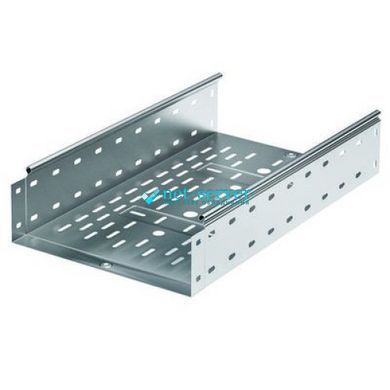



|
Quantity
|
Out of stock
|
||
|
|
|||
|
|
|||
DKC Perforated Cable Tray 80×200×3000 mm
The DKC perforated cable tray 80×200×3000 mm is designed for the organized routing of power, data, telecommunications, control, and low-voltage cables. The 200 mm width provides high cable capacity, while the 80 mm side height increases structural rigidity and allows cables to be arranged in several layers.
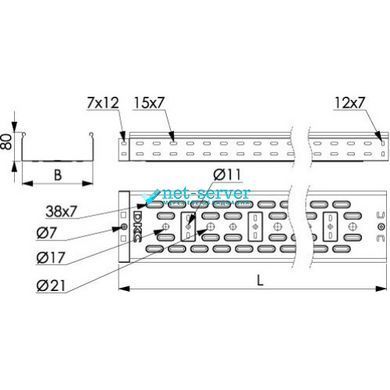
The tray is 80 mm high, 200 mm wide, and 3000 mm, or 3 metres, long. This size is suitable for creating extended cable management systems with a large number of cables in industrial, commercial, and infrastructure facilities. Hot-dip galvanizing using the Sendzimir process protects the steel surface against corrosion and extends the product’s service life.
Perforated Construction
Perforations in the base and side walls provide natural air circulation around the cables, improve heat dissipation, and help maintain an optimal operating temperature within the cable system. They also reduce the overall weight of the tray and simplify installation work.
The mounting holes allow cables to be secured quickly with cable ties, internal dividers to be installed, and additional accessories to be attached. The open perforated construction provides convenient access to the cable route during inspection, maintenance, or the installation of new lines.
Sendzimir Hot-Dip Galvanizing
The tray is manufactured from steel with a protective zinc coating applied using the Sendzimir process. During production, the steel sheet undergoes continuous hot-dip galvanizing, creating a uniform corrosion-resistant layer on its surface.
This coating protects the metal against corrosion, increases the durability of the cable management system, and is primarily suitable for indoor use in dry environments with normal humidity levels. The installation location and environmental conditions should be considered when selecting the tray.
Advantages of the DKC Perforated Cable Tray
- 80×200 mm dimensions for high-capacity cable routes;
- 200 mm width allows a large number of cables to be installed;
- 80 mm side height provides increased structural rigidity;
- cables can be arranged in several layers;
- 3000 mm, or 3 m, section length;
- effective ventilation and natural cable cooling;
- convenient cable fastening with cable ties;
- internal dividers can be installed;
- fewer joints along extended cable routes;
- reduced installation time;
- corrosion-resistant Sendzimir galvanized coating;
- compatible with DKC covers, connectors, supports, brackets, bases, and hangers.
Applications
The DKC 80×200 mm perforated cable tray is suitable for cable routing in:
- industrial and manufacturing facilities;
- warehouses and logistics centres;
- office and administrative buildings;
- retail and commercial facilities;
- server rooms and data centres;
- electrical switch rooms and technical areas;
- engineering and infrastructure facilities;
- automation and supervisory control systems;
- CCTV, fire alarm, and access control systems;
- power distribution, data transmission, and telecommunications networks.
Main Specifications
- Type: perforated cable tray;
- Brand: DKC;
- Height: 80 mm;
- Width: 200 mm;
- Length: 3000 mm;
- Section length: 3 m;
- Material: steel;
- Coating: Sendzimir hot-dip galvanizing;
- Construction: perforated;
- Capacity: high;
- Purpose: routing, organizing, and mechanically protecting cable routes.
Installation Features
The tray is installed using compatible DKC supports, brackets, bases, hangers, connector plates, and other mounting components. A suitable cover can be used for additional cable protection, while internal dividers can separate power, data, and low-voltage lines.
Before installation, determine the number and total weight of the cables, the installation method, the distance between supports, and the permitted load on the supporting structures. The support spacing should be selected according to the actual load to prevent tray deflection or deformation.
Frequently Asked Questions
What do the dimensions 80×200×3000 mm mean?
The tray has an 80 mm side height, a 200 mm base width, and a section length of 3000 mm, or 3 metres.
What types of cables are suitable for the DKC 80×200 mm tray?
The tray is suitable for routing power, data, telecommunications, control, and low-voltage cables. Its 200 mm width allows high-capacity cable routes to be created.
What are the advantages of the 80 mm height?
The 80 mm side height increases structural rigidity, expands the usable internal volume, and allows cables to be arranged in several layers.
What is the purpose of the perforation?
The perforation provides cable route ventilation, improves heat dissipation, reduces the weight of the tray, and simplifies the fastening of cables and mounting accessories.
What is the difference between a perforated and a non-perforated cable tray?
A perforated cable tray provides better ventilation and more convenient cable fastening. A non-perforated tray has a solid base that provides additional protection against dust, small contaminants, and foreign objects.
Can power and data cables be separated?
Yes. Compatible DKC dividers can be installed inside the tray to separate cable lines of different types and keep the installation organized.
Can the tray be installed on a wall or under a ceiling?
Yes. The tray can be mounted on a wall, under a ceiling, or on metal structures using suitable supports, brackets, bases, and hangers.
Is a cover required?
A cover is not mandatory, but it is recommended when the cable route requires additional protection against dust, accidental contact, or mechanical damage.
Are mounting accessories included?
Covers, dividers, connectors, supports, brackets, bases, hangers, and other mounting components are usually supplied separately.
How do I calculate the required number of trays?
Divide the total planned cable route length by 3 metres. The calculation should also include an allowance for bends, branches, joints, section cutting, and installation requirements.
The DKC perforated cable tray 80×200×3000 mm with Sendzimir hot-dip galvanizing is a professional solution for creating strong, high-capacity, and well-ventilated cable management systems in industrial, commercial, and infrastructure facilities.