
 zakaz@net-server.com.ua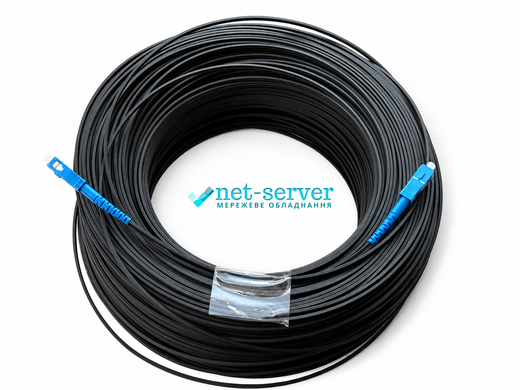



|
Quantity
|
Out of stock
|
||
|
|
|||
|
|
|||
SC-SC Fiber Optic Patch Cord, SM G.652.D, 50 m, Dielectric with Transition, FTTH001-SM-01
SC-SC FTTH001-SM-01 fiber optic patch cord, 50 m long — a ready-to-use solution for connecting subscriber and telecommunications equipment in fiber optic networks. The patch cord is manufactured using ITU-T G.652.D single-mode optical fiber and is equipped with SC-SC connectors on both ends.
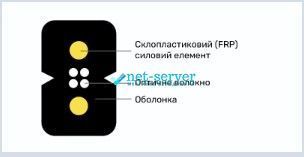
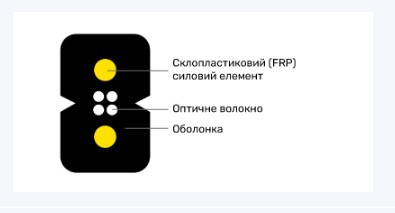
The product is based on a flat subscriber cable of the FTTH001-SM-01 type with a fully dielectric construction. Two fiberglass strength members FRP are positioned on both sides of the optical fiber to provide mechanical reinforcement. There are no metallic strength members in the construction, so the cable does not require grounding and does not conduct electrical current.
The transition design provides a neat transition from the flat FTTH cable to the connector section of the patch cord, improving installation convenience and protecting the transition area from excessive mechanical stress.
The outer jacket is made of LSZH material (Low Smoke Zero Halogen), which provides low smoke emission and contains no halogens. This jacket is well suited for use in residential, office, technical, and telecommunications premises.
Application
FinMark FTTH001-SM-01 distribution fiber optic cable belongs to the «last mile» cable category and is designed for use in FTTH (Fiber To The Home) networks.
The cable is intended for installation inside buildings: in risers, attics, basements, conduits, cable ducts and trunking, along baseboards, as well as in offices, apartments, private houses, and other premises.
Thanks to its compact flat construction, FTTH001-SM-01 can be easily fixed to flat surfaces and is simple and convenient to strip, route, and install.
The fully dielectric construction allows the cable to be used in environments exposed to electromagnetic interference. The absence of metallic strength members eliminates the need for grounding.
Where it is used
The patch cord is designed for connecting end subscribers and organizing optical lines in FTTH, FTTB, and PON networks. It can be used to connect:
- ONU and ONT terminals;
- fiber optic subscriber outlets;
- fiber optic boxes and distribution frames;
- media converters;
- optical switches;
- other equipment with compatible SC interfaces.
The cable can be conveniently routed in apartments, private houses, offices, entrances, risers, attics, basements, cable ducts, trunking, conduits, and other protected cable routes.
Important: FTTH001-SM-01 is a dielectric subscriber cable without a separate messenger wire or supporting cable. It is not designed for self-supporting aerial suspension between poles or supports. For aerial installations, a special self-supporting FTTH cable with an appropriate messenger or strength member must be used.
Construction
The FTTH001-SM-01 cable contains one optical fiber compliant with ITU-T G.652.D — a standard single-mode optical fiber with a suppressed «water peak».
The outer jacket is made of LSZH (Low Smoke Zero Halogen) — a halogen-free, low-smoke, flame-retardant material.
Resistance to longitudinal tensile stress is provided by two fiberglass FRP (Fiber Reinforced Plastic) strength members located on both sides of the optical fiber. This construction provides mechanical strength while maintaining fully dielectric properties.
Advantages
- G.652.D single-mode fiber — widely used in telecommunications fiber optic networks;
- fully dielectric construction — no metallic strength members;
- two FRP rods provide additional mechanical strength;
- SC-SC — factory-terminated connectors on both ends;
- transition design for convenient and neat connection;
- LSZH jacket — low smoke emission and halogen-free material;
- compact flat profile 2.0 × 3.0 mm;
- suitable for FTTH, FTTB, PON networks;
- ready for use without the need to install connectors;
- patch cord length — 50 m.
Main specifications
| Product type | Fiber optic patch cord based on FTTH cable |
| Cable model | FTTH001-SM-01 |
| Fiber type | Single Mode |
| Fiber standard | ITU-T G.652.D |
| Number of optical fibers | 1 |
| Connectors | SC-SC |
| Length | 50 m |
| Construction | Flat, dielectric |
| Strength members | 2 fiberglass FRP rods |
| Strength member diameter | 0.5 mm |
| Metallic messenger element | Not present |
| Jacket material | LSZH (Low Smoke Zero Halogen) |
| Cable size | 2.0 × 3.0 mm |
| Nominal cable weight | approx. 8.5 kg/km |
| Maximum tensile load | 100 N (short-term) |
| Maximum crush resistance | 1000 N/100 mm (short-term) |
| Minimum bending radius | 30 mm static / 60 mm dynamic |
| Operating temperature | from -30°C to +60°C |
| Aerial suspension between supports | Not intended |
Features of the dielectric construction
The absence of metallic strength members makes the cable electrically non-conductive. Two FRP rods provide the required mechanical support for the optical fiber and help protect it from longitudinal tensile stress during installation.
The dielectric construction is especially convenient in areas where metallic elements are undesirable or where additional cable grounding should be avoided.
Frequently Asked Questions
1. What type of fiber is used in this patch cord?
The patch cord uses ITU-T G.652.D single-mode optical fiber.
2. Is the cable fully dielectric?
Yes. FTTH001-SM-01 uses two fiberglass FRP strength members, and there is no metallic messenger element.
3. What does «with transition» mean?
This patch cord design includes a transition from the main flat FTTH cable section to the connector section, making the finished cable more convenient for equipment connection.
4. Does this cable need to be grounded?
No. Due to its dielectric construction, the cable strength members do not require grounding.
5. Can this cable be suspended between poles?
No. FTTH001-SM-01 does not have a separate messenger wire or support cable and is not designed for self-supporting aerial installation between supports.
6. Where is this patch cord best used?
It is suitable for subscriber connections in FTTH/PON networks, installation inside buildings, cable ducts, conduits, trunking, risers, technical rooms, and for connecting ONU/ONT terminals, optical distribution frames, and fiber boxes.
7. Can the cable be bent sharply?
Sharp bends should be avoided when using G.652.D fiber. The recommended minimum bending radius of the base cable is approximately 30 mm in a static position and 60 mm during installation.