
 zakaz@net-server.com.ua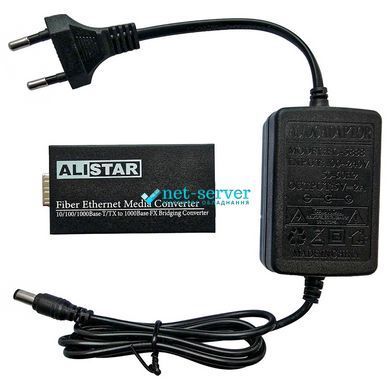


|
Quantity
|
Out of stock
|
||
|
|
|||
|
|
|||
Alistar Mini Gigabit 10/100/1000BASE-T Media Converter with 1000BASE-SX/LX SFP Slot, LFP and External Power Supply
The Alistar Mini Gigabit media converter with an SFP slot is designed to convert a 10/100/1000BASE-T Ethernet signal into a 1000BASE-SX or 1000BASE-LX optical signal. It allows copper-based network equipment to be connected to a fiber-optic link while giving the user the flexibility to select a suitable SFP transceiver according to the fiber type, optical connector, wavelength, and required transmission distance.
The media converter features an RJ45 port supporting 10/100/1000 Mbps and a universal SFP slot for a Gigabit optical transceiver. This design makes it a flexible solution for building, upgrading, and extending local area networks, video surveillance systems, server infrastructure, and communication links between remote facilities.
Support for LFP (Link Fault Pass-Through) helps detect connection failures in time. If the signal is lost on one side of the link, the media converter passes the fault status to the opposite port, simplifying network diagnostics and reducing troubleshooting time.
Main advantages of the Alistar Mini media converter
- Data rate up to 1 Gbps — supports 10BASE-T, 100BASE-TX, and 1000BASE-T network standards.
- Universal SFP slot — allows the optical transceiver to be selected according to the requirements of a particular link.
- 1000BASE-SX/LX support — compatible with multimode and single-mode SFP transceivers.
- LFP support — forwards link failure information between the optical and Ethernet ports.
- Compact Mini form factor — convenient for installation in a telecommunications cabinet, server room, or near network equipment.
- External power supply — provides straightforward connection to the power source.
- Flexible optical link configuration — transmission distance, fiber type, and connector depend on the installed SFP transceiver.
Why an SFP slot is useful
Unlike media converters with an integrated optical transceiver, this model is equipped with a separate SFP slot. The user can install a compatible SFP module according to the specific requirements of the network.
Depending on the selected transceiver, the media converter can operate:
- with single-mode or multimode optical fiber;
- over one or two optical fibers;
- with LC or SC connectors;
- at different optical wavelengths;
- over short, medium, or long transmission distances;
- in conventional duplex or single-fiber WDM/BiDi links.
The SFP transceiver should not be considered an integrated part of the media converter. Its inclusion and availability should be checked separately in the product specifications.
LFP function for network status monitoring
LFP (Link Fault Pass-Through) is a function that forwards information about a link failure. If the optical or copper connection is interrupted on one side of the link, the media converter reports the loss of connectivity to the equipment on the opposite side.
This is especially useful in corporate networks, video surveillance systems, and remote installations where a faulty link section must be identified quickly without manually checking the entire connection.
Applications
- connecting Ethernet equipment to a fiber-optic network;
- linking switches located in different buildings or rooms;
- creating communication links for IP cameras and network video recorders;
- extending local and corporate networks;
- connecting servers, routers, and other network equipment;
- building optical links in warehouses, industrial, and commercial facilities;
- replacing copper connections with fiber-optic links over long distances.
Technical specifications
| Device type | Gigabit media converter with SFP slot |
| Brand | Alistar |
| Form factor | Mini |
| Copper interface | 10/100/1000BASE-T |
| Ethernet connector | RJ45 |
| Optical interface | SFP slot |
| Supported optical standards | 1000BASE-SX / 1000BASE-LX depending on the SFP transceiver |
| Data transmission rate | Up to 1 Gbps |
| LFP support | Yes |
| Fiber type | Depends on the installed SFP transceiver |
| Optical connector | Depends on the installed SFP transceiver |
| Transmission distance | Depends on the installed SFP transceiver |
| Power supply | External power adapter |
How to choose the correct SFP transceiver
For proper operation, a Gigabit SFP transceiver compatible with the 1000BASE-SX or 1000BASE-LX standard must be installed. The following parameters should be considered when choosing a module:
- fiber type — single-mode or multimode;
- number of fibers — one or two;
- optical connector type — LC or SC;
- required transmission distance;
- operating wavelength;
- compatibility of the transceivers at both ends of the optical link;
- the need for WDM/BiDi or DDM support.
For a single-fiber WDM connection, paired SFP transceivers with complementary transmit and receive wavelengths must be used, for example TX1310/RX1550 nm and TX1550/RX1310 nm.
Connection recommendations
- Install a compatible SFP transceiver in the media converter’s SFP slot.
- Connect the fiber-optic patch cord to the installed SFP transceiver.
- Connect the RJ45 Ethernet port to a switch, router, camera, or other network device.
- Connect the external power adapter.
- Check the power, Ethernet link, and optical connection indicators.
Frequently asked questions
Is the SFP transceiver included?
The package contents should be checked in the specifications of the particular product listing. The media converter has an SFP slot, while the required optical transceiver may be supplied separately.
Which SFP transceiver can be installed?
A Gigabit SFP transceiver supporting 1000BASE-SX or 1000BASE-LX is required. The exact model should be selected according to the fiber type, connector, wavelength, and required transmission distance.
Can a single-fiber WDM SFP transceiver be used?
Yes, provided that the transceiver is compatible with the media converter. Paired WDM modules with complementary TX and RX wavelengths must be installed at both ends of the link.
What determines the maximum transmission distance?
The maximum distance depends on the specifications of the installed SFP transceiver, the type and quality of the optical fiber, the number of connections, and the total optical loss of the link.
What is the purpose of the LFP function?
The LFP function forwards link failure information between the copper and optical ports. This simplifies network diagnostics and helps identify a faulty section more quickly.
The Alistar Mini Gigabit 10/100/1000BASE-T media converter with an SFP slot is a flexible solution for connecting Ethernet equipment to a fiber-optic network. The ability to select the SFP transceiver separately makes it possible to adapt the device to different fiber types, connectors, wavelengths, and transmission distances.