 zakaz@net-server.com.ua
AWG24, AWG23, AWG26: What Cable Conductor Thickness Means and How to Choose
When choosing a network cable, buyers often pay attention to the Cat5e, Cat6 or Cat6A category, UTP or FTP shielding type, conductor material and cable jacket. However, there is another important parameter that directly affects installation, network stability and compatibility with RJ45 connectors — AWG.
AWG indicates the thickness of the cable conductor. This parameter affects how well the cable transmits signal and power, whether it is suitable for PoE, and which RJ45 connectors should be used during installation.
In this article, we will explain what AWG24, AWG23 and AWG26 mean, why a smaller AWG number means a thicker conductor, which cable is better for internet, PoE and video surveillance, and which connectors are suitable for Cat6 cable with a thick conductor.
What Is AWG in a Cable?
AWG stands for American Wire Gauge. It is a standard used to indicate conductor thickness. In network cables, AWG usually refers to the diameter of the copper or bimetallic conductor inside the cable.
The main rule is simple: the smaller the AWG number, the thicker the cable conductor.
For example:
- AWG26 — thinner conductor;
- AWG24 — medium and very common option;
- AWG23 — thicker conductor;
- AWG22 — even thicker conductor.
This means that an AWG23 cable has a larger conductor diameter than AWG24 or AWG26.
AWG24, AWG23, AWG26 — What Is the Difference?
The most common values in twisted pair cables and patch cords are AWG26, AWG24 and AWG23. They differ in conductor thickness, flexibility, signal loss and ease of installation.
| AWG | Approximate Conductor Diameter | Features | Where It Is Used |
|---|---|---|---|
| AWG26 | about 0.40 mm | Thinner conductor, more flexibility, higher resistance | Short patch cords, equipment patching |
| AWG24 | about 0.51 mm | Universal option for most networks | Cat5e, office and home networks |
| AWG23 | about 0.57 mm | Thicker conductor, lower loss, better reserve for PoE | Cat6, Cat6A, PoE, longer cable runs |
If the cable specifications indicate a conductor diameter of about 0.57 mm, it most often corresponds to AWG23. Such a cable usually has a thicker conductor and requires properly selected RJ45 connectors.
Why Conductor Thickness Matters for a Network
Conductor thickness affects not only installation convenience, but also the quality of network operation. The thicker the conductor, the lower its electrical resistance. This is especially important for long cable runs, PoE power transmission and systems that must operate reliably without failures.
A thicker conductor usually provides the following advantages:
- lower signal loss;
- better stability over longer distances;
- better power transmission through PoE;
- less heating under load;
- greater reserve for modern networks.
However, there is one important detail: a cable with a thicker conductor may not fit standard low-cost RJ45 connectors, especially if it is a Cat6 or Cat6A cable.
Which AWG Is Better for Twisted Pair Cable?
For most network tasks, twisted pair cable with AWG24 or AWG23 is used.
AWG24 is often found in Cat5e cables. It is a good universal option for home internet, office networks, RJ45 socket connections and standard gigabit networks.
AWG23 is more often used in Cat6 and Cat6A cables. Such cable has a thicker conductor and is better suited for longer lines, PoE, IP cameras, office networks and systems with future reserve.
AWG26 is more common in flexible patch cords. It is acceptable for short connections between devices, but for long fixed cable runs or PoE, a thicker conductor is recommended.
AWG for Cat5e, Cat6 and Cat6A
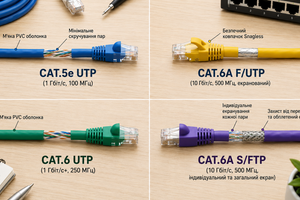
The cable category is often related to conductor thickness, but it is not the same thing. Cat5e, Cat6 and Cat6A are data transmission categories, while AWG describes conductor thickness.
| Cable Category | Typical AWG | Features |
|---|---|---|
| Cat5e | AWG24 or AWG26 | Suitable for most gigabit networks |
| Cat6 | AWG23 or AWG24 | Better stability reserve, thicker conductor, more demanding installation |
| Cat6A | AWG23 | Professional networks, larger cable diameter, often shielded design |
You can read more about the difference between categories in the article what is the difference between Cat5e and Cat6.
Which AWG Is Better for PoE?
For PoE, the cable must reliably transmit not only data but also power. That is why it is better to use a cable with a thicker copper conductor.
For most PoE connections, a good choice is copper Cat5e or Cat6 twisted pair cable with AWG24 or AWG23 conductors.
For long cable runs, IP cameras, access points and equipment that operates 24/7, it is better to choose:
- copper cable;
- Cat5e or Cat6;
- AWG24 or AWG23;
- quality RJ45 connectors;
- proper crimping or professional toolless solutions.
For PoE, it is not recommended to use cheap CCA cable, especially on long lines. Due to higher resistance, it may cause voltage loss, unstable equipment operation or cable heating.
You can read more about choosing a cable for PoE in the article which cable to choose for PoE.
Copper or CCA: How Is It Related to AWG?
AWG indicates conductor thickness, but it does not indicate conductor material. Therefore, two cables with the same AWG can perform differently if one is copper and the other is CCA.
Copper cable has better electrical conductivity, lower losses and is better suited for PoE, long cable runs, video surveillance and critical networks.
CCA is an aluminum conductor with a thin copper coating. Even if it looks similar to copper cable from the outside, its performance is lower than pure copper.
That is why it is important to check not only AWG, but also the conductor material: CU, copper or CCA.
You can read more about this difference in the article copper cable vs CCA.
Why Cat6 Cable with a Thick Conductor May Not Fit a Standard RJ45 Connector
One of the most common problems when installing Cat6 cable is a thicker conductor and a larger insulation diameter. Because of this, a standard Cat5e RJ45 connector may not fit properly.
Possible problems include:
- conductors are difficult to insert into the connector;
- wires do not reach the contacts;
- the contact after crimping is unreliable;
- the connector does not hold the cable properly;
- the line does not pass testing;
- the network works unstably.
That is why Cat6 or Cat6A cables with thicker conductors require connectors designed for a larger conductor diameter.
Which Connectors to Choose for Cat6 Cable with a Thick Conductor
If you have a Cat6 cable with a conductor of about 0.57 mm or thick insulation, it is better to use Cat6, Cat6A or Cat7 RJ45 connectors with an insert. The insert helps arrange the wires correctly before crimping and ensures reliable contact.
For such tasks, you can consider:
- RJ45 STP Cat.7 1.5 mm connector with insert L&W LW-US070 — suitable for cables with a larger conductor diameter and shielded lines;
- RJ45 STP Cat.6A 1.45 mm connector with insert Kingda KD-PG8056 — a good option for Cat6 and Cat6A cables with thicker conductors;
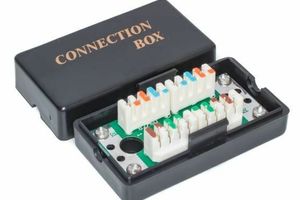
- toolless RJ45 connectors — a convenient solution when you need installation without classic crimping or want to simplify the connection.
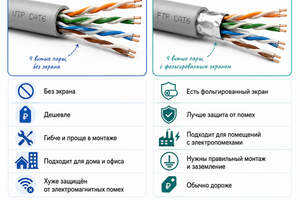
If the cable is shielded, it is better to use a shielded FTP or STP connector. If the cable is unshielded, a UTP connector of the appropriate category is usually enough.
You can read more about choosing connectors in the article how to choose an RJ45 connector.
Which Cable to Choose for Internet
For regular home internet, Cat5e AWG24 twisted pair cable is usually enough. Such cable supports gigabit connection and is suitable for most home tasks.
If you need reserve for the future, use modern equipment or install a new network in a house or office, it is better to consider Cat6 AWG23 or AWG24.
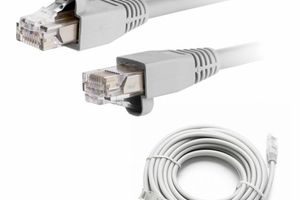
For short connections between devices, ready-made patch cords can be used.
Which Cable to Choose for Video Surveillance
For IP surveillance cameras, it is important to consider not only the cable category, but also conductor material, AWG and PoE support.
For video surveillance, it is better to use copper Cat5e or Cat6 twisted pair cable. If cameras are powered via PoE or the lines are long, it is better to choose a cable with a thicker conductor — AWG24 or AWG23.
You can read more about this in the article which cable to choose for video surveillance.
Common Mistakes When Choosing AWG, Cable and Connector
- choosing a cable only by category without considering AWG;
- using thin CCA cable for PoE;
- trying to crimp thick Cat6 cable with a standard Cat5e connector;
- ignoring conductor and insulation diameter;
- using a UTP connector for shielded FTP cable;
- poor crimping without testing;
- saving money on connectors for critical networks;
- using an unsuitable crimping tool.
What Products Are Used Together with Network Cable?
For quality network installation, it is important to choose not only the cable but also the right accessories.
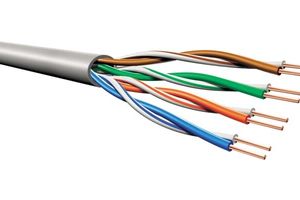
- twisted pair cable — for building local networks, internet connections and video surveillance;
- RJ45 connectors — for crimping cable and connecting equipment;
- toolless RJ45 connectors — for convenient installation without classic crimping;
- patch cords — for short connections between devices;
- crimping tools — for professional installation of RJ45 connectors;
- RJ45 keystone modules — for installation in sockets, patch panels and workstations.
Properly selected components help avoid poor contact, signal loss, unstable network operation and PoE problems.
FAQ
What Does AWG Mean in a Cable?
AWG indicates the thickness of the cable conductor. The smaller the AWG number, the thicker the conductor. For example, AWG23 is thicker than AWG24 and AWG26.
What AWG Is 0.57 mm?
A conductor of about 0.57 mm most often corresponds to AWG23. Such cable is often found in Cat6 or Cat6A.
Which AWG Is Better for PoE?
For PoE, it is better to use copper cable with AWG24 or AWG23 conductors. For long cable runs and IP cameras, a thicker conductor is recommended.
Will a Standard RJ45 Cat5e Connector Fit Cat6 Cable?
Not always. If the Cat6 cable has a thick conductor or larger insulation diameter, a standard Cat5e connector may not fit. It is better to use Cat6, Cat6A or Cat7 connectors with an insert.
Which Is Better — AWG23 or AWG24?
AWG23 has a thicker conductor and lower loss, so it is better suited for Cat6, Cat6A, PoE and longer runs. AWG24 is a universal option for most standard networks.
Useful Categories
- Twisted Pair Cable
- RJ45 Connectors
- Toolless RJ45 Connectors
- Patch Cords
- Crimping Tools
- RJ45 Keystone Modules
Useful Articles
- What Is the Difference Between Cat5e and Cat6
- What Is the Difference Between UTP and FTP
- Copper Cable vs CCA
- Which Cable to Choose for PoE
- How to Choose an RJ45 Connector
- How to Choose a Patch Cord
Conclusion
AWG is an important parameter of a network cable that indicates conductor thickness. The smaller the AWG number, the thicker the conductor and the better the cable is suited for long runs, PoE and critical networks.
For most home and office networks, AWG24 is suitable. For Cat6, Cat6A, PoE, video surveillance and longer lines, AWG23 is a better option. If the conductor diameter is about 0.57 mm, RJ45 connectors should be selected carefully, because standard Cat5e connectors may not fit.
Need help choosing a cable or connectors? Net-Server specialists will help you select twisted pair cable, RJ45 connectors, toolless connectors and crimping tools for your specific tasks.