 zakaz@net-server.com.ua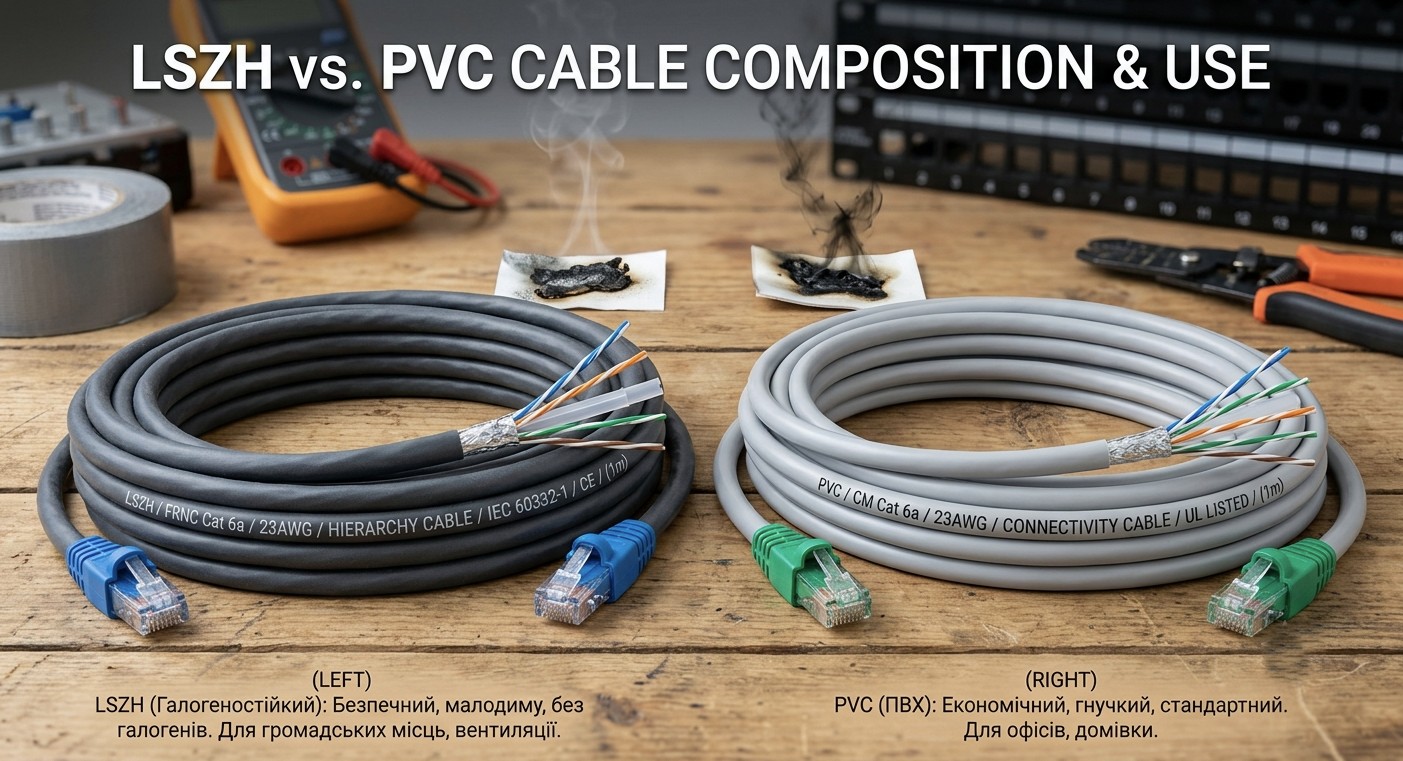
LSZH vs PVC: Which Cable to Choose and What Is the Difference
When choosing twisted pair cables, patch cords, or other network cables, most buyers look at the cable category, data transfer speed, or conductor material. However, an equally important parameter is the type of outer cable jacket.
Most modern cables are manufactured with either an LSZH or a PVC jacket. This material directly determines how the cable behaves during heating or fire, as well as its operating conditions.
In this article, we will explore what LSZH and PVC are, the key differences between them, and which cable is best suited for home use, offices, server rooms, or video surveillance systems.
What is LSZH
LSZH (Low Smoke Zero Halogen) — is a cable jacket material characterized by low smoke emission and the complete absence of halogens.
In the event of overheating or ignition, LSZH emits significantly less smoke and does not produce large amounts of toxic gases. Unlike PVC, the LSZH jacket contains no halogens, such as chlorine. When PVC burns, it can release aggressive and toxic compounds that are dangerous to humans and can damage electronic equipment. This is why LSZH cables are widely used in facilities with strict fire safety requirements.
LSZH cables are frequently deployed in facilities that must comply with modern fire safety regulations and corporate installation standards.
- office centers;
- server rooms;
- data centers;
- hospitals;
- educational institutions;
- hotels;
- shopping malls;
- residential complexes.
What is PVC
PVC (Polyvinyl Chloride) — is a polyvinyl chloride jacket, which is one of the most common materials used in cable production.
The primary advantages of PVC are its affordable cost, good mechanical strength, and versatility.
As a result, a significant portion of cable products intended for home use features a PVC jacket.
However, when burning, PVC can emit thick smoke and toxic substances, which is its main drawback compared to LSZH.
Key Differences Between LSZH and PVC
The main difference lies in how the material behaves during combustion.
| Feature | LSZH | PVC |
|---|---|---|
| Smoke emission | Minimal | High |
| Toxicity of combustion products | Low | Higher |
| Presence of halogens | None | Present |
| Fire safety | Higher | Lower |
| Cost | Higher | Lower |
| Recommended for offices and server rooms | Yes | Limited |
LSZH or PVC for Twisted Pair
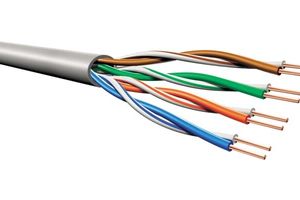
When selecting a twisted pair cable, it is essential to consider not only the category but also the jacket type. PVC is often used for home networks due to its lower cost. For offices, server rooms, educational institutions, and public areas, LSZH is highly recommended due to its enhanced fire safety and low smoke properties.
If the cable is being routed inside a building where a high volume of cable lines is planned, LSZH is generally the proper choice for safety and compliance with modern installation requirements.
Which Cable is Better for Home Use
For most home networks, both LSZH and PVC cables can be utilized.
If the primary criterion is budget friendliness, PVC is a solid choice.
However, if extra safety for family members and minimizing risks in case of fire are your priorities, it is better to opt for a cable with an LSZH jacket.
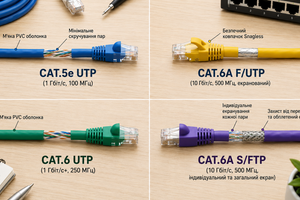
For home internet setups, Cat5e or Cat6 twisted pair cables are most commonly used.
LSZH vs PVC for Offices
For office spaces, it is highly recommended to use LSZH cables.
In the event of a fire, they emit significantly less smoke, which facilitates emergency evacuation and assists rescue operations.
Consequently, many modern business centers and commercial facilities utilize cables with an LSZH jacket.
LSZH vs PVC for Server Rooms
For server rooms, telecom closets, and data centers, LSZH is almost always recommended.
The reasons are clear:
- high concentration of cables in a single space;
- stringent fire safety standards;
- protection of expensive infrastructure equipment;
- compliance with modern structured cabling standards.
LSZH vs PVC for Video Surveillance
Both jacket types can be used for CCTV and video surveillance systems.
If the cameras are being installed inside an office, school, hospital, or any other public building, an LSZH cable is the recommended choice.
For outdoor installations, it is crucial to consider more than just the fire safety rating; UV resistance, moisture resistance, and temperature fluctuations are key. For outdoor routing, cables with a specialized PE (Polyethylene) jacket are typically used, as they provide high resistance to environmental factors.
Standard LSZH and PVC cables are primarily designed for indoor use unless otherwise specified by the manufacturer.
What Products are Used Together with Cables
To build a local network, cables are frequently paired with the following components:
- twisted pair cables;
- patch cords;
- RJ45 connectors;
- RJ45 network modules (keystone jacks);
- RJ45 internet wall outlets;
- crimping tools.
Properly selected components ensure stable network performance and maximize the lifespan of your cable infrastructure.
Common Mistakes in Selecting Cable Jackets
- focusing solely on price;
- ignoring fire safety codes and regulations;
- using PVC in high-occupancy or crowded areas;
- making the wrong cable choice for server environments;
- failing to leave room for future network scalability.
FAQ
What does LSZH stand for?
LSZH stands for Low Smoke Zero Halogen — indicating low smoke emission and the absence of halogen elements.
What does PVC stand for?
PVC stands for Polyvinyl Chloride, a plastic compound widely used in cable manufacturing.
Which cable is safer — LSZH or PVC?
From a fire safety perspective, LSZH is considerably safer due to its minimal smoke production and lack of toxic halogen gases.
Why is LSZH more expensive?
Due to more complex manufacturing processes and the specialized materials required to achieve fire-retardant properties.
Is LSZH necessary for home use?
It is not mandatory, but if safety and risk reduction are priorities, LSZH is the superior choice.
Useful Categories
Related Articles
- Difference Between Cat5e and Cat6
- Difference Between UTP and FTP
- How to Crimp an RJ45 Cable
- Which Cable to Choose for Video Surveillance
Conclusion
If budget friendliness is the overarching criterion, cables with a PVC jacket remain a popular and highly practical option. However, if fire safety, low smoke density, and adherence to modern requirements are top priorities, you should opt for cables with an LSZH jacket.
For offices, server rooms, data centers, educational facilities, and other areas with strict security codes, LSZH is currently considered the industry-recommended solution.
Need help choosing the right cable? The technical experts at Net-Server are ready to help you select twisted pair, patch cords, and necessary components to build a dependable network tailored to your specific goals and budget.