 zakaz@net-server.com.ua
🔍 What is Fiber Optics — How it Works, Types and Benefits
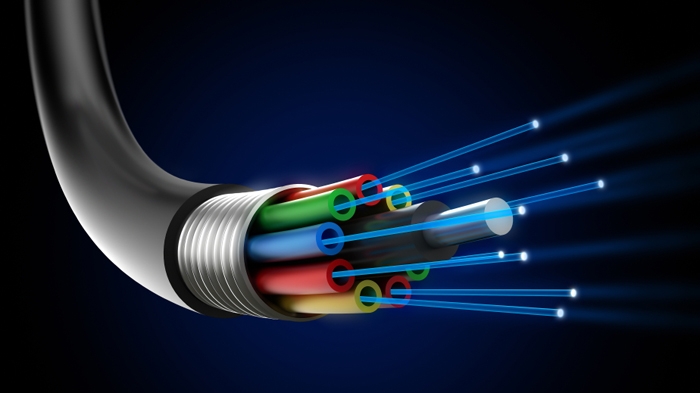
Fiber optics or a fiber optic cable is a modern data transmission technology that uses ultra-thin strands of glass or plastic to carry light impulses. This ensures ultra-high speed and stable connectivity even over long distances.
⚙️ How Fiber Optics Work
At the core of the cable is a core (pure glass or high-quality plastic) and a cladding with a lower refractive index. This allows for total internal reflection, so the light signal (photons) travels inside the cable without loss. On the receiving equipment, it is converted into an electrical signal (electrons) for further processing.
📌 Benefits of Fiber Optic Cable
- 🚀 High transmission speed — up to 100 Gbps and more.
- 📡 Resistance to interference — not affected by electromagnetic or radio frequency interference.
- 📏 Long distance transmission — delivers signal over tens or even hundreds of kilometers without amplifiers.
- 💡 Minimal signal loss — stable and high-quality connection at any distance.
- 🔒 Security — virtually impossible to intercept data without damaging the cable.
🔍 Types of Fiber Optic Cables
There are several types of fiber optics, including:
- Single-mode (SM) — for long-distance data transmission at maximum speed.
- Multi-mode (MM) — for shorter distances (up to 2 km) but with high bandwidth.
📊 How to Choose a Cable by Fiber Count
The number of fibers in a fiber optic cable determines how many separate data transmission channels it can provide. Our catalog offers models from 1 to 48 fibers, with the most popular being:
- 1–4 fibers — for connecting individual devices or small networks.
- 8–12 fibers — the optimal choice for offices and medium-sized network infrastructures.
- 24–48 fibers — for backbone lines and large-scale telecommunications projects.
The choice depends on current and future network needs — it’s always better to have extra fibers for future upgrades. Check out all models in our fiber optic cable section.
🏢 Where Fiber Optics Are Used
Today, fiber optic technologies are used in:
- 🌐 Internet service providers and telecommunications
- 🏭 Industrial networks and automation systems
- 🏥 Medical equipment
- 🎥 Video transmission in 4K/8K format
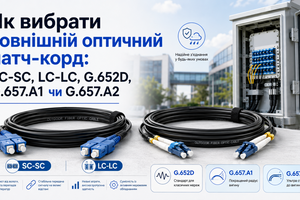
🔌 Fiber Optic Patch Cords
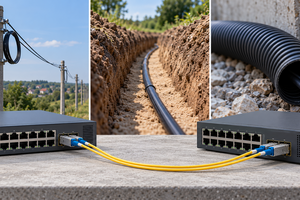
To connect a fiber optic cable to network equipment, fiber optic patch cords are used. These are ready-made cables with factory-installed connectors on both ends, ensuring stable and high-quality connectivity.
Benefits of Fiber Optic Patch Cords:
- 🔧 Easy and quick installation.
- 📶 Minimal signal loss.
- 🔗 Compatible with various connector types (SC, LC, FC, etc.).
🎯 Fiber Optics in HDMI Cables
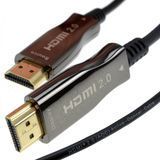
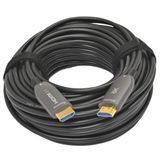
In addition to Internet signal transmission, fiber optic technologies are also used in HDMI cables. Such cables provide stable video and audio transmission in high quality over long distances without quality loss.
For example, a fiber optic HDMI cable can transmit 4K and 8K video with 10/12-bit color depth and HDR support even at distances over 50 meters, which is not possible with traditional copper HDMI cables.
🔹 Advantages of Fiber Optic HDMI Cables:
- 📏 Signal transmission over long distances without loss.
- 🎥 Support for 4K/8K, HDR, Dolby Vision formats.
- ⚡ High speed and resistance to electromagnetic interference.
🛒 Where to Buy Fiber Optic Cable?
If you need a reliable and certified fiber optic cable, check out our fiber optic cables section. We offer cables for indoor and outdoor installation, patch cords, connectors, and other installation accessories.
💡 Tip: Before choosing, consider the type of fiber (SM or MM), installation environment, and required bandwidth. Our specialists will help you choose the best option for your project.
📞 Order Now!
✅ Quality guarantee
✅ Delivery across Ukraine
✅ Expert consultation