 zakaz@net-server.com.ua
19-Inch Rack for an Inverter and Batteries: How to Organize the Installation Properly
Backup power systems with inverters and battery modules are increasingly being installed in private homes, offices, shops, server rooms and technical facilities. When a system consists of an inverter, several battery modules and additional components, an important question arises: how can all this equipment be installed safely, efficiently and in a space-saving way?
One possible solution is a 19-inch single-frame rack or a specially designed structure based on it. An open rack provides convenient access to equipment, helps organize cables and allows all system components to be arranged in one technical installation.
Additional metal components can also be used when building a custom mounting structure. For example, a 19-inch 4U blanking panel CMS UA-BP4U-B may serve as part of an inverter mounting assembly, while a CMS-1980 triangular support bracket may be used as an additional supporting element for reinforcing a shelf mounting assembly.
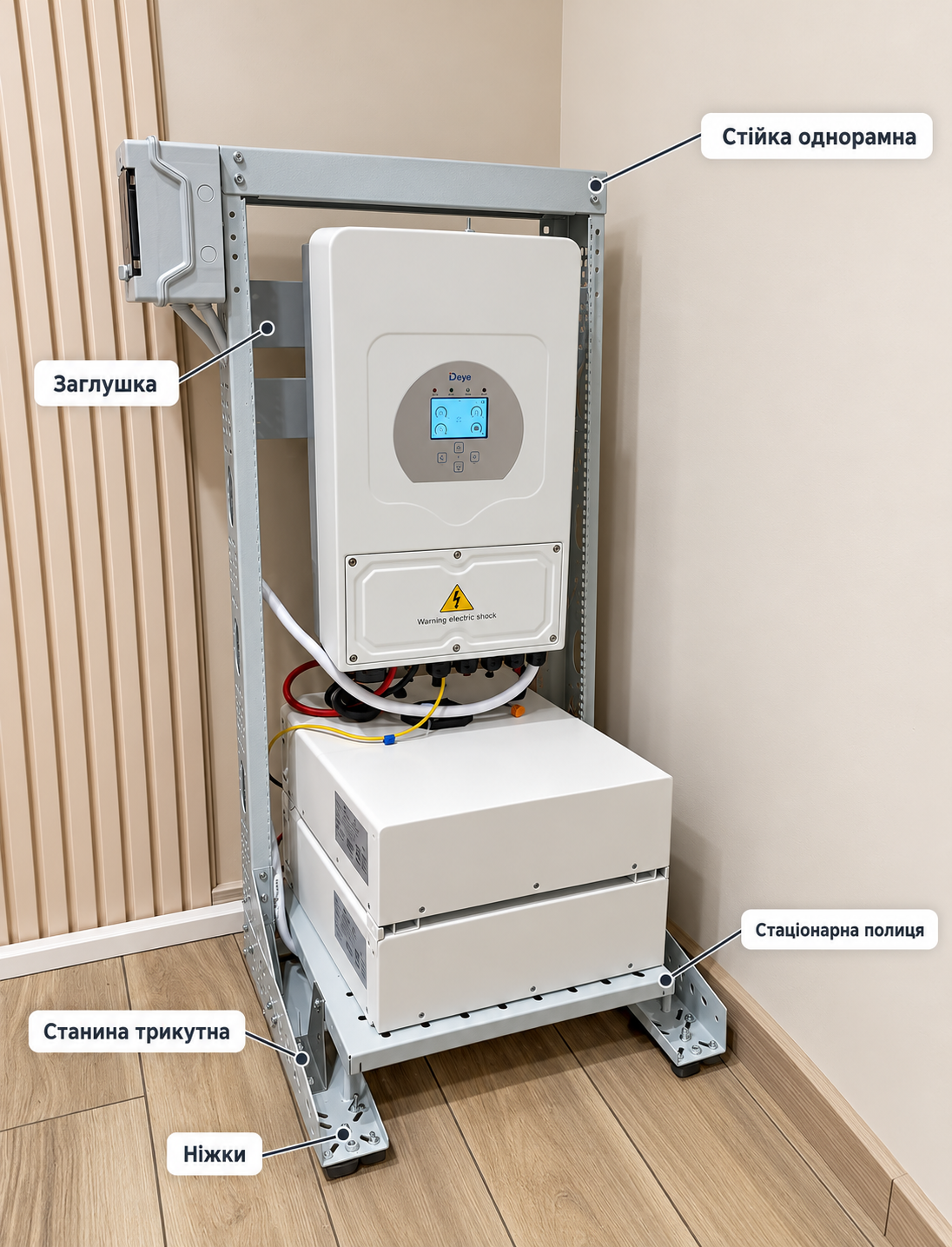
The photographs show an example of a structure equipped with Deye products: the inverter is positioned in the upper section, the battery modules are installed below, and the components are arranged within one structure. This configuration can be convenient, but before installation, the load-bearing capacity of the supports, inverter mounting method, weight distribution, ventilation and electrical safety must be carefully checked.
In this article, we will explain how to choose a 19-inch rack for a backup power system, the differences between single-frame and two-frame racks, how to account for battery weight, which rack height to choose — 24U, 33U or 42U — how to use a 4U blanking panel and triangular brackets, and what to consider during installation.
Why Use a 19-Inch Rack for a Backup Power System?
When an inverter, batteries and auxiliary devices are installed separately, the equipment may occupy a considerable amount of space. Cable routing, maintenance and the organization of the technical room can also become more complicated.
An open 19-inch rack helps to:
- organize equipment within a single technical area;
- make efficient use of available floor space;
- provide convenient access to system components;
- organize power and signal cables;
- reserve space for auxiliary equipment;
- arrange ventilation according to manufacturers' requirements;
- simplify inspection, maintenance and future upgrades.
However, it is important to understand that a standard telecommunications rack and a specialized load-bearing battery frame are different structures. Not every 19-inch rack is designed to directly support heavy batteries or a wall-mounted inverter.
Is a 19-Inch Single-Frame Rack Suitable for an Inverter and Batteries?
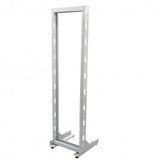
A 19-inch single-frame server rack has one pair of vertical mounting rails. It offers a compact design, provides open access to equipment and can serve as a basis for organizing a technical installation.
The Net-Server catalog includes CMS single-frame racks with heights of 24U, 33U and 42U. These steel structures are designed for installing compatible 19-inch equipment.
Advantages of single-frame racks include:
- open-frame construction;
- compact dimensions;
- access to equipment from the front, sides and rear;
- convenient cable management;
- different available rack heights;
- compatibility with suitable accessories;
- convenient use in technical rooms.
Building a non-standard mounting system may require shelves, mounting panels, brackets, additional supports and other metal components.
Important: a single-frame rack has only one pair of mounting rails and is not designed for standard four-point mounting of heavy servers, deep shelves or UPS units. Installing batteries or inverters is possible only with a separately verified engineering solution that includes suitable supports and mounting hardware.
Which Rack Height Should You Choose: 24U, 33U or 42U?
The rack height should be selected according to the amount of equipment, its actual dimensions, required ventilation clearances and maintenance accessibility.
One rack unit (1U) equals 44.45 mm. However, calculating only the height in rack units is not sufficient. For inverters and battery modules, physical dimensions, weight and the method of mechanical support must also be considered.
| Rack Height | CMS Rack Dimensions | Application Features |
|---|---|---|
| 24U | 1160 × 540 × 560 mm | A compact structure for a small technical installation and auxiliary equipment |
| 33U | 1590 × 540 × 560 mm | More vertical space for organizing equipment and cables |
| 42U | 2025 × 540 × 560 mm | Suitable for systems requiring greater height and additional equipment space |
These dimensions refer to the corresponding CMS single-frame rack models. A base depth of 560 mm does not mean that any device of the same depth can be safely mounted using only one pair of rails.
When choosing the rack height, avoid filling the entire available space without considering ventilation. The clearances specified by the inverter and battery manufacturers must be maintained.
Why Battery Weight Is the Main Selection Criterion
Battery modules are often the heaviest components of a backup power system. This is especially true for installations containing several LiFePO4 battery modules or other high-capacity batteries.
When selecting a mounting structure, consider:
- the weight of each battery module;
- the total number of batteries;
- the inverter weight;
- the weight of shelves, mounting panels and additional brackets;
- the total load on the supporting structure;
- the position of the center of gravity;
- the load applied to wheels, leveling feet or the base;
- the floor type and the risk of the structure tipping over.
For example, when several batteries are installed, their actual weights must be added together with the inverter weight and all additional components. The resulting load must then be checked against the allowable load of every structural supporting element.
For certain CMS single-frame racks, the specifications indicate a load capacity of up to 200 kg when the equipment depth does not exceed 300 mm. This rating cannot automatically be applied to an installation containing heavy batteries, an inverter, extended platforms or equipment with a different center of gravity.
Main rule: heavy equipment must transfer its weight to a specially designed base, support platform or structure with verified load-bearing capacity. A few standard screws installed in the front mounting rails should not be assumed sufficient to support a heavy battery.
How to Position Battery Modules Correctly
Battery positioning depends on the battery type, construction and manufacturer's requirements. Some battery models are designed for installation in dedicated battery racks or cabinets, while others are intended for floor mounting.
When organizing the system, follow these principles:
- heavy batteries should generally be positioned as low as possible;
- each module must have adequate mechanical support;
- batteries must be installed in an orientation approved by the manufacturer;
- ventilation openings and maintenance areas must remain unobstructed;
- terminals, connectors, indicators and communication ports must remain accessible;
- cables must not be subjected to excessive tension or contact with sharp metal edges;
- batteries must be protected against accidental movement and mechanical damage.
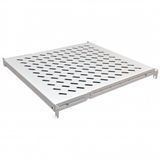
Heavy battery modules may require a dedicated floor-mounted platform, a reinforced battery frame or another suitable support structure. A standard cantilever shelf intended for network equipment may not be suitable for such loads.
How to Reinforce a Shelf Support in a 19-Inch Single-Frame Rack
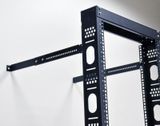
A 19-inch single-frame rack has one pair of vertical mounting rails. When equipment extends forward from the mounting plane, it creates additional bending forces on the rails and shelf mounting points. This is especially important when heavy battery modules are installed.
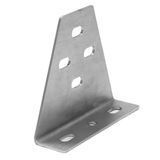
For a custom additional support, the CMS-1980 triangular support bracket, 130 × 110 × 34.5 mm, 3 mm steel can be considered.
This triangular metal bracket is manufactured from 3 mm thick galvanized steel. Its standard application is mounting cable channels and other compatible equipment to supporting surfaces.
In a specially designed structure, this component may be used to create an additional support point or reinforce a shelf mounting assembly, provided that dimensions, mounting holes, fasteners and allowable loads have been verified.
The triangular shape of the bracket makes it possible to create an additional support point. However, the actual effectiveness of the reinforcement depends on how the bracket is secured and which structural elements receive the load.
When designing additional support, consider:
- the combined weight of the batteries and shelf;
- the shelf depth and center of gravity;
- the mounting positions of the triangular brackets;
- the number of supports and the method of load distribution;
- the strength of the vertical rails and rack base;
- the allowable load on bolted connections;
- the stability of the structure against tipping.
For example, when a shelf containing batteries is installed in a single-frame rack, additional triangular supports may be used as part of a custom mounting solution. The primary load must be transferred through suitable load-bearing elements rather than relying only on the thin front section of the shelf.
Important: adding triangular brackets does not automatically increase the manufacturer's rated load capacity of the rack or shelf. For heavy batteries, the complete load-bearing structure must be checked. If necessary, a separate floor support, a two-frame rack or a specialized battery rack should be used.
How to Install an Inverter Correctly
An inverter has its own mounting requirements. Most wall-mounted models are designed to be installed using a dedicated mounting bracket or another supporting surface capable of carrying their weight.
Before installation, check:
- the permitted inverter orientation;
- the mounting method recommended by the manufacturer;
- the inverter weight;
- the required ventilation clearances;
- access to the display and controls;
- power and signal cable routing;
- temperature and humidity requirements;
- maintenance accessibility.
If the inverter is to be mounted on a separate metal panel or inside a custom-built structure, the panel and its fasteners must be designed to withstand the corresponding load.
Do not change the manufacturer's prescribed mounting method or obstruct the inverter's ventilation openings. Exact cooling clearances must be taken from the installation manual of the particular inverter model.
How to Mount an Inverter on a 19-Inch 4U Metal Panel
A metal mounting panel can be considered when installing an inverter in a custom structure based on a 19-inch server rack. One available component for such a solution is the CMS UA-BP4U-B 19-inch 4U black blanking panel.
This product is manufactured from steel, follows the standard 19-inch mounting width and occupies 4U of rack height. Its primary purpose is to cover unused spaces in server cabinets and racks.
In a specially engineered mounting solution, this panel may be used as one component of an inverter mounting assembly, provided that its mechanical suitability is confirmed and the necessary structural reinforcement is included.
Advantages of using a 19-inch metal panel as part of a custom mounting assembly include:
- standard 19-inch mounting width;
- 4U height for accommodating mounting components;
- metal construction;
- integration into a compatible server rack;
- convenient positioning within the equipment layout.
Before mounting an inverter, check:
- the weight of the specific inverter model;
- the distance between the mounting holes of its bracket;
- the panel's load-bearing capacity and how the load is transferred to the frame;
- the availability of additional supports or reinforcing components;
- whether the inverter manufacturer permits this type of installation;
- the required ventilation clearances and access to cable connections.
If the inverter is heavy, the mounting panel must work together with additional load-bearing components that transfer its weight to a suitable supporting structure. Simply attaching a heavy inverter to a standard blanking panel without verifying its strength is not sufficient.
Important: the CMS UA-BP4U-B blanking panel is not a ready-made, manufacturer-certified inverter mounting bracket. It may only be used for this purpose as part of an individually engineered mounting system.
Single-Frame vs. Two-Frame Rack: Which Is Better for Batteries?
The choice between a single-frame rack and a 19-inch two-frame rack primarily depends on the equipment construction, weight and mounting method.
| Criterion | Single-Frame Rack | Two-Frame Rack |
|---|---|---|
| Mounting rails | One pair | Two pairs — front and rear |
| Typical applications | Network equipment, cable organization and compact technical installations | Deeper equipment, compatible shelves and devices requiring four-point mounting |
| Heavy batteries | Requires a separate support structure or an engineered mounting solution | Compatible batteries may be installed using appropriately rated rails or shelves |
| Inverter mounting | Requires a separately designed mounting panel or support | Possible when the mounting system is compatible and the load rating is sufficient |
| Additional reinforcement | May include separate supports, metal brackets and reinforcing components | Four-point supported shelves and suitable rails may be used |
| Stability | Center of gravity and tipping risks require particular attention | Depends on the base, dimensions, load and floor anchoring |
If standard 19-inch equipment requires support at four mounting points, a two-frame rack or a specialized battery cabinet is generally a more appropriate option.
A single-frame structure may be used to organize auxiliary equipment or as part of a custom technical installation. However, it should not replace a properly designed load-bearing structure for heavy batteries without engineering calculations.
Example of a Deye Inverter and Battery Installation
The photographs show an example of Deye equipment organized within an open metal structure.
The inverter with its control display is positioned in the upper section. Battery modules and power cables can be seen below, while the open sides provide access to the components.
This configuration demonstrates how a backup power system can be arranged compactly. Metal panels, brackets, supports and other components, including 19-inch 4U blanking panels and triangular support brackets, may be used when developing similar custom structures.
However, the photographs alone do not establish the exact rack model, equipment weight, load calculations or compliance of the mounting hardware with manufacturer requirements.
Before recreating a similar installation, the following must be checked individually:
- Dimensions and weight of all battery modules.
- How the batteries are supported by the base or a dedicated platform.
- The inverter mounting system.
- Suitability of a 4U metal mounting panel.
- Whether additional triangular shelf supports are required.
- Load-bearing capacity of the rack and all additional components.
- Stability of the structure against tipping.
- Equipment cooling requirements.
- Safe routing of power cables.
- Connection and maintenance conditions.
This approach allows the advantages of an open-frame structure to be used without compromising mechanical or electrical safety.
Can the System Be Installed on Wheels?
A mobile structure may be convenient for moving equipment during installation or maintenance. Caster wheels and adjustable supports are available for server racks.
However, when working with heavy battery modules, it is particularly important to check:
- the load rating of each wheel;
- the load capacity of the base and wheel mounting points;
- the stability of the structure;
- the availability of wheel locking mechanisms;
- whether moving the equipment is permitted;
- the reliability of cable connections.
Wheels suitable for an empty telecommunications rack may not be suitable for a structure containing heavy batteries. Moving a connected system may also create a risk of damaging cables.
For a stationary backup power system, a rigid floor-mounted structure or specially designed base is often more appropriate.
Ventilation for Inverters and Battery Modules
The open construction of the rack facilitates air circulation, but it does not eliminate the ventilation requirements specified by inverter and battery manufacturers.
For safe operation:
- maintain the minimum required ventilation clearances;
- do not obstruct inverter ventilation openings;
- avoid installing equipment in excessively humid locations;
- keep the system away from sources of excessive heat;
- provide access for cleaning and maintenance;
- observe the permitted battery operating temperature range;
- protect the system against dust, accidental contact and foreign objects.
If necessary, ventilation equipment may be used for compatible auxiliary infrastructure. However, its use must not conflict with the requirements of the inverter or battery manufacturer.
How to Organize Cables and Grounding
A system containing an inverter and batteries includes both power and signal connections. These connections must be organized so that they do not interfere with maintenance or create a risk of damage.
Cable organizers, hook-and-loop cable ties and suitable protective accessories can be used to keep cables arranged neatly.
Key recommendations include:
- route cables according to equipment documentation;
- avoid excessive cable tension;
- protect cables from sharp metal edges;
- separate signal and power cables according to installation requirements;
- provide access to protection and switching devices;
- label cables and connections;
- provide protective grounding of metal components according to the electrical design.
Net-Server also offers grounding busbars for telecommunications cabinets and racks. These components should only be considered part of a grounding system when they meet the requirements of the electrical design.
Warning: power connections for inverters, batteries, circuit breakers and protective devices must be completed by a qualified electrician in accordance with the manufacturers' instructions and applicable electrical safety requirements.
How to Choose a 19-Inch Rack for an Inverter and Batteries: Step-by-Step Guide
- Identify the inverter and battery models.
- Check their weight, dimensions and approved mounting methods.
- Calculate the total weight of the equipment and mounting hardware.
- Determine which components require separate load-bearing platforms.
- Check height, depth and ventilation clearance requirements.
- Select a single-frame rack, two-frame rack or specialized battery rack.
- Verify whether a 19-inch 4U metal panel can be used as part of a custom inverter mounting assembly.
- Determine whether additional triangular brackets are needed to support the shelves.
- Check the load applied to the mounting rails, base, shelves and fasteners.
- Provide protection against tipping and accidental movement.
- Plan cable routing, grounding and electrical protection.
- Have the mounting solution reviewed by a qualified specialist before installation.
Only after these steps should the rack and its accessories be selected and ordered.
Common Mistakes When Installing Inverters and Batteries on Racks
- choosing a rack based only on its height in U;
- not considering the actual battery weight;
- placing heavy batteries on shelves without checking their rated load;
- mounting heavy equipment using only the front pair of rails;
- using a 4U blanking panel as a load-bearing bracket without verifying its strength;
- installing triangular supports without load calculations or checking the fasteners;
- not verifying the inverter mounting bracket design;
- ignoring the center of gravity and tipping risks;
- using caster wheels without checking their load capacity;
- failing to maintain the required ventilation clearances;
- blocking access to electrical connections;
- failing to provide proper grounding;
- not separating power and signal cables;
- installing equipment without following inverter and battery manufacturer instructions.
Products Commonly Purchased with 19-Inch Racks
The following products may be needed when organizing a technical installation with an inverter, batteries and auxiliary equipment:
- 19-inch single-frame racks — for compatible telecommunications equipment and custom-designed technical installations;
- 19-inch two-frame racks — for equipment requiring both front and rear mounting rails;
- 19-inch server shelves — for compatible equipment, subject to the load rating of the specific shelf;
- CMS UA-BP4U-B 19-inch 4U black blanking panel — a steel panel that may be used as a component of a custom-designed inverter mounting assembly, provided suitable reinforcement and load verification are included;
- CMS-1980 triangular support bracket, 3 mm steel — a metal component for creating additional support or reinforcing a custom shelf mounting assembly after checking compatibility and loads;
- adjustable leveling feet — for compatible structures with an appropriate load rating;
- rack caster wheels — when a mobile structure is included in the design;
- cable organizers — for keeping cables neat and organized;
- grounding busbars — for protective connections according to the electrical design;
- ventilation equipment — for compatible technical installations requiring additional airflow;
- 19-inch power distribution units (PDUs) — for appropriately rated auxiliary equipment, not as a replacement for a dedicated inverter power connection.
FAQ — Frequently Asked Questions
Can Batteries Be Installed on a 19-Inch Server Rack?
Yes, provided the batteries are designed for this installation method and the structure has verified load capacity and appropriate supports. Heavy batteries may require a dedicated battery rack, a two-frame structure or a separate support platform.
Is a Single-Frame Rack Suitable for LiFePO4 Batteries?
A standard single-frame rack is not intended for unrestricted installation of heavy batteries. Its suitability depends on the structure, equipment weight, support method and engineering calculations.
Can a Deye Inverter Be Installed on a 19-Inch Rack?
This depends on the specific inverter model and mounting structure. Wall-mounted Deye inverters generally require suitable attachment to a reliable load-bearing surface. Installation inside a custom frame requires verification of the manufacturer's requirements and the mechanical strength of the mounting system.
Can an Inverter Be Mounted on a 19-Inch 4U Blanking Panel?
The CMS UA-BP4U-B steel blanking panel may be considered as a component of a custom mounting solution. However, the manufacturer does not designate it as a ready-made load-bearing inverter bracket. Before installation, the equipment weight, mounting method and any necessary additional supports must be verified.
How Can a Battery Shelf Be Reinforced in a Single-Frame Rack?
Triangular steel brackets, including the 3 mm thick CMS-1980, may be considered for creating additional support. However, the reinforcement design requires verification of the load, fasteners, shelf and rack structure. Heavy batteries may require a separate support platform or a two-frame rack.
Does a Triangular Bracket Increase the Maximum Rack Load Capacity?
No. Simply installing an additional bracket does not increase the manufacturer's rated load capacity of the rack. A triangular bracket may form part of an additional supporting structure, but its effectiveness depends on the mounting method, geometry and load-bearing capacity of the entire assembly.
Which Rack Height Is Better: 24U, 33U or 42U?
The required height depends on the number of devices, their dimensions and ventilation clearances. A 24U rack is a compact option, 33U provides more vertical space, and 42U is suitable for taller installations. However, rack height alone does not determine allowable equipment weight.
How Much Weight Can a Single-Frame Rack Support?
For example, certain CMS models have a specified load capacity of up to 200 kg when the equipment depth does not exceed 300 mm. This does not mean that any combination of batteries or inverters may be installed. The mounting method, center of gravity and actual load distribution must be considered.
Can Batteries Be Positioned at the Bottom of the Rack?
Placing batteries lower in the structure may help reduce the center of gravity. However, this is acceptable only when an appropriate load-bearing platform or other engineered support is provided and the battery manufacturer's requirements are followed.
Can an Inverter Be Installed Above the Batteries?
This depends on manufacturer instructions, required installation clearances, ventilation and safety requirements. Equipment should not be stacked vertically solely to save space without confirming that the arrangement is permitted.
Can a Rack with Wheels Be Used?
Only if the structure, wheels, fasteners and cable connections are designed for the corresponding load and operating conditions. A rigidly mounted support is often more appropriate for heavy stationary systems.
Is Ventilation Clearance Necessary?
Yes. Inverters and battery modules have specific operating temperature and cooling requirements. The clearances stated in the documentation for the particular equipment must be maintained.
Does a Metal Rack Need to Be Grounded?
Protective grounding and equipotential bonding must be provided according to the electrical design, equipment specifications and applicable electrical safety requirements.
Which Is Better for Heavy Batteries: a Single-Frame or Two-Frame Rack?
For equipment requiring four-point mounting, a two-frame rack or specialized battery structure is generally more suitable. The final choice depends on battery weight, rail and shelf construction, and verified load ratings.
Useful Articles
- How to Choose a 19-Inch Server Rack: Dimensions, Height and Load Capacity
- How to Choose a 19-Inch Server Cabinet: Wall-Mounted, Floor-Standing, 6U, 9U, 12U or 42U
- How to Choose a 19-Inch Server Shelf: Depth, Load Capacity and Type
- How to Choose Server Cabinet Ventilation: Fans, Thermostat and Cooling
Conclusion
A 19-inch rack can serve as a useful foundation for organizing backup power equipment. Its open construction helps save space, arrange cables and provide access to system components.
Additional metal components may be considered when developing a custom mounting solution. In particular, the CMS UA-BP4U-B 19-inch 4U blanking panel may form part of an inverter mounting assembly, while the CMS-1980 triangular support bracket may provide additional shelf support in a single-frame rack. Such solutions require load verification and confirmation of mounting compatibility.
When installing an inverter and battery modules, it is important to consider not only rack height but also equipment weight, platform load capacity, mounting methods, center of gravity, structural stability, ventilation and electrical safety.
For a small technical installation, a single-frame rack may be considered if the equipment is compatible or a specially engineered mounting solution is provided. For heavy battery modules, equipment requiring four-point mounting and high-load systems, a two-frame rack or specialized battery rack is often a more appropriate choice.
Looking for a 19-inch rack for an inverter, batteries or other technical equipment? At Net-Server, you can find single-frame and two-frame racks, server shelves, 4U metal blanking panels, CMS-1980 triangular brackets, cable organizers, mounting accessories and other components. For custom installations, we recommend confirming equipment dimensions, loads and mounting design before placing an order.
Explore 19-Inch Single-Frame Racks in the Net-Server Catalog