 zakaz@net-server.com.ua
Which Cable to Choose for PoE: Cat5e, Cat6, Copper or CCA
When connecting IP cameras, Wi-Fi access points, intercoms, or other network equipment, PoE technology is often used. It allows data and power to be transmitted through a single cable, without the need for a separate power supply near the device.
However, stable PoE operation directly depends on choosing the right cable. If you use a low-quality twisted pair cable, a cable with bimetallic conductors, or the wrong cable category, you may experience voltage drops, overheating, camera reboots, or unstable network performance.
In this article, we will explain which cable is best for PoE, whether Cat5e is enough, when Cat6 is a better choice, why copper conductors are important, and which mistakes should be avoided during installation.
What Is PoE?
PoE (Power over Ethernet) is a technology that allows power and data to be transmitted through a single Ethernet cable. With PoE, a device can be connected to the network and powered through the same cable.
PoE is commonly used for:
- IP surveillance cameras;
- Wi-Fi access points;
- IP phones;
- intercom systems;
- access control devices;
- other network equipment.
That is why choosing the right cable for PoE is important not only for data transmission speed, but also for stable power delivery.
Which Cable Is Suitable for PoE?
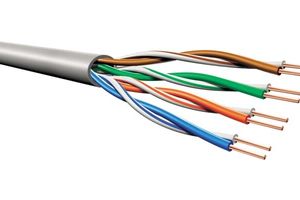
For most PoE connections, a twisted pair network cable of Cat5e, Cat6, or Cat6A category is used.
The most important cable parameters for PoE are:
- conductor material;
- cable category;
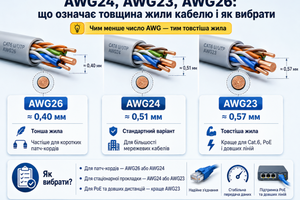
- conductor gauge;
- cable run length;
- jacket type;
- quality of connectors and crimping.
For stable PoE operation, it is best to use a cable with copper conductors. Such a cable has lower resistance, transmits power better, heats up less, and ensures stable operation of connected equipment.
Copper Cable or CCA for PoE
For PoE, it is recommended to use a copper cable. A pure copper cable has better electrical conductivity and lower voltage loss over long distances.
CCA, or bimetallic cable, has an aluminum core with a thin copper coating. Such cable is cheaper, but it is less suitable for PoE because of higher resistance and greater power loss.
CCA cable can cause problems such as:
- unstable operation of IP cameras;
- periodic equipment reboots;
- voltage drops over long cable runs;
- cable heating under load;
- shorter network service life.
You can read more about the difference between copper and bimetallic cable in the article copper cable vs CCA.
Cat5e or Cat6 for PoE
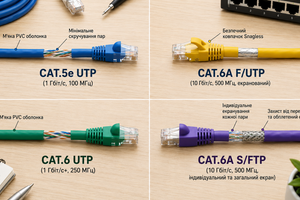
For most standard PoE applications, Cat5e cable is sufficient. It supports speeds up to 1 Gbps and is suitable for most IP cameras, access points, home networks, and office networks.
Cat6 is a better choice if you need more bandwidth headroom, lower interference, and better long-term network stability.
| Cable Category | When to Use for PoE |
|---|---|
| Cat5e | For most IP cameras, Wi-Fi access points, and gigabit networks |
| Cat6 | For offices, longer cable runs, more connected devices, and future-proofing |
| Cat6A | For high-load networks, server rooms, modern infrastructure, and maximum performance reserve |
If you are choosing a cable for a standard IP camera or a small network, Cat5e is usually enough. If the system is being built for many years, Cat6 is worth considering.
You can read more about the difference between these categories in the article what is the difference between Cat5e and Cat6.
UTP or FTP for PoE
Both UTP and FTP cables can be used for PoE. The right choice depends on the installation conditions.
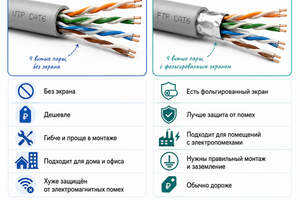
UTP is an unshielded twisted pair cable. It is suitable for most home and office networks if there are no power cables or sources of electromagnetic interference nearby.
FTP is a shielded twisted pair cable. It is better suited for more demanding installation conditions, industrial facilities, server rooms, or cable runs near power lines.
| Cable Type | When to Choose |
|---|---|
| UTP | For apartments, houses, offices, and standard installation conditions |
| FTP | For installation near power cables, in server rooms, or in environments with interference |
You can read more about the difference between these cable types in the article what is the difference between UTP and FTP.
What Is the Maximum Cable Length for PoE?
For Ethernet networks, the standard recommended cable run length is up to 100 meters. This rule also applies to PoE.
However, it is important to understand that when power is transmitted over a long cable run, voltage loss may occur. The longer the line and the higher the power consumption of the equipment, the more important the cable quality becomes.
For long PoE cable runs, it is better to use:
- copper cable;
- high-quality Cat5e or Cat6 twisted pair cable;
- cable with sufficient conductor gauge;
- reliable RJ45 connectors;
- proper professional crimping.
Which Cable to Choose for PoE Cameras
For IP cameras with PoE, it is best to use copper Cat5e or Cat6 twisted pair cable. If the camera is installed indoors, a good-quality UTP or FTP cable is usually sufficient, depending on the installation conditions.
If the cable is installed outdoors, you should pay attention not only to the category, but also to the type of outer jacket. For outdoor installation, cables resistant to moisture, UV radiation, and temperature changes should be used.
You can read more about choosing a cable for cameras in the article which cable to choose for video surveillance.
LSZH or PVC for PoE
The cable jacket type also matters. For offices, server rooms, educational institutions, and other public buildings, it is recommended to use cable with an LSZH jacket. This jacket produces less smoke during fire and contains no halogens.
For home networks, PVC is often used because of its lower cost. For outdoor installation, a special outdoor cable should be selected, usually with a PE jacket that is resistant to moisture and UV radiation.
You can read more about cable jackets in the article LSZH or PVC: which cable to choose.
What Accessories Are Needed for PoE Connection?
For a reliable PoE connection, not only the cable matters, but also the accessories used during installation.
The following products are commonly used together with the cable:
- twisted pair cable;
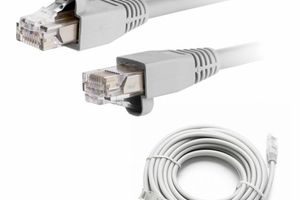
- patch cords;
- RJ45 connectors;
- RJ45 keystone modules;
- RJ45 network sockets;
- crimping tools;
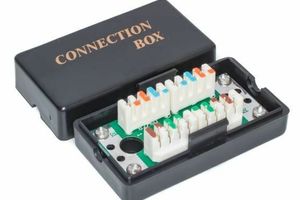
- cable junction boxes.
Even a good cable may work unstably if poor-quality connectors are used or the cable is crimped incorrectly.
Common Mistakes When Choosing a Cable for PoE
- using CCA cable for PoE cameras;
- choosing the cheapest cable without checking the conductor material;
- installing a long cable run without considering voltage loss;
- using poor-quality RJ45 connectors;
- incorrect cable crimping;
- using indoor cable for outdoor installation;
- ignoring installation conditions and electromagnetic interference.
FAQ
What cable is needed for PoE?
For PoE, it is recommended to use copper Cat5e or Cat6 twisted pair cable. Cat5e is enough for most standard tasks, while Cat6 provides more headroom for the future.
Can CCA cable be used for PoE?
It is not recommended. CCA has higher resistance, transmits power worse, and may cause unstable equipment operation.
Is Cat5e or Cat6 better for PoE?
Cat5e is suitable for most PoE devices. Cat6 is better for offices, longer cable runs, more equipment, or when additional performance headroom is needed.
What is the maximum PoE cable length?
The recommended Ethernet cable run length is up to 100 meters. For long runs, it is especially important to use high-quality copper cable.
Is UTP or FTP better for PoE?
UTP is suitable for standard conditions. FTP is better where electromagnetic interference is present or where the cable runs near power lines.
Useful Categories
- Twisted Pair Cable
- Patch Cords
- RJ45 Connectors
- RJ45 Keystone Modules
- RJ45 Network Sockets
- Crimping Tools
Useful Articles
- What Is the Difference Between Cat5e and Cat6
- What Is the Difference Between UTP and FTP
- Copper Cable vs CCA
- Which Cable to Choose for Video Surveillance
- LSZH or PVC: Which Cable to Choose
Conclusion
For PoE, it is best to use copper Cat5e or Cat6 twisted pair cable. Cat5e is suitable for most IP cameras, access points, and standard network devices, while Cat6 provides greater stability and performance headroom for the future.
CCA cable is not recommended for PoE, especially when it comes to long cable runs, video surveillance, or equipment that operates 24/7. Higher resistance and voltage loss may lead to unstable device operation.
Need help choosing a cable for PoE? Net-Server specialists will help you select twisted pair cable, patch cords, RJ45 connectors, and other accessories for stable network operation.