 zakaz@net-server.com.ua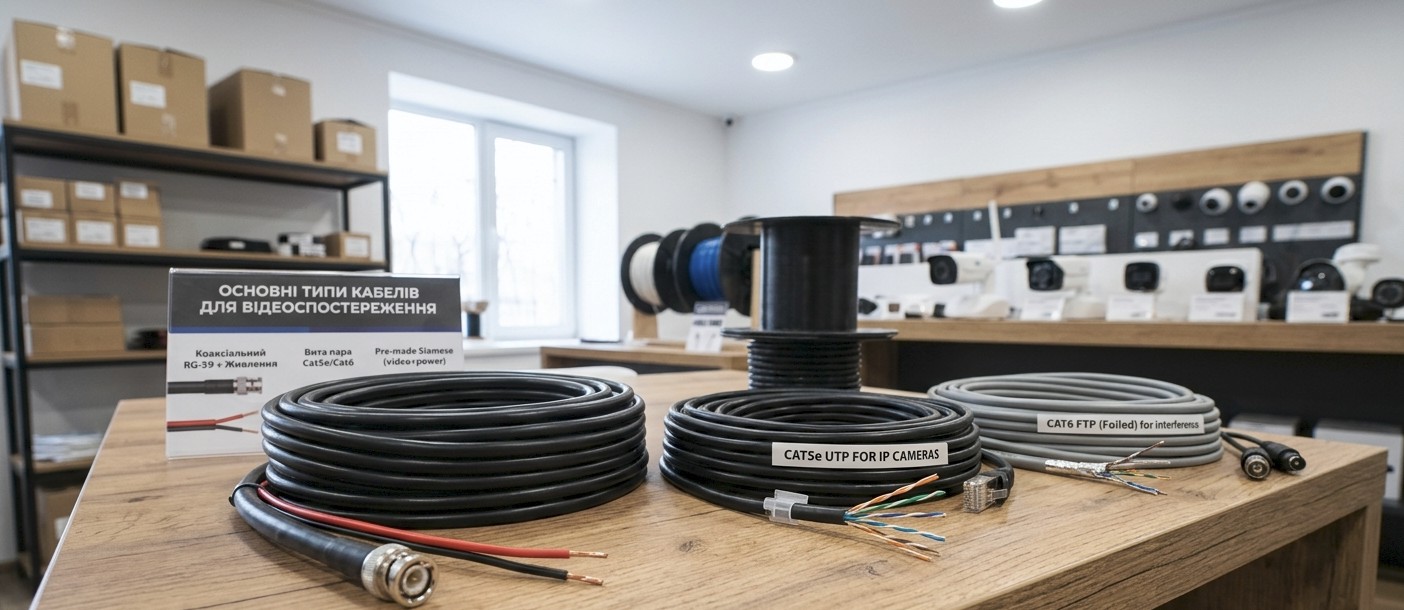
Which cable to choose for video surveillance — UTP, FTP, Cat5e, or Cat6
When installing a video surveillance system, one of the most critical questions is choosing the right cable. The stability of the cameras, video transmission quality, and overall system reliability directly depend on it.
Today, twisted pair cable is most commonly used for IP cameras. But which option should you choose: UTP or FTP? Cat5e or Cat6? Do you need a more expensive cable for PoE cameras?
In this article, we will examine the main differences, explore technical nuances, and help you choose the best option for your facility.
What cable is used for security cameras
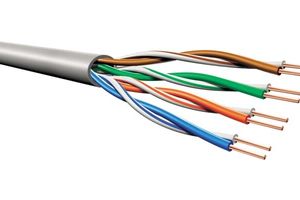
For modern IP cameras, Cat5e or Cat6 Ethernet cable is predominantly used.
This cable allows you to:
- transmit high-definition digital video signals without delays;
- provide simultaneous power to cameras using PoE technology;
- connect cameras to network switches and network video recorders (NVR);
- create scalable video surveillance systems of any complexity.
For most standard installations, Cat5e cable is more than enough, but in certain cases, it is more practical to use Cat6. Below, we will break down each selection criterion in detail.
Coaxial cable vs. twisted pair for video surveillance
Two main types of cable are used for video surveillance systems: coaxial cable and twisted pair.
Coaxial cable is most frequently used in analog or format-based video surveillance systems:
- AHD;
- HD-TVI;
- HD-CVI;
- traditional CCTV systems.
The most common option is the RG59 cable, which ensures stable video signal transmission over significant distances and is often used when upgrading existing analog video surveillance systems.
For modern digital IP cameras, twisted pair of Cat5e or Cat6 category is preferred.
The main advantages of twisted pair are:
- data and power transmission over a single cable via PoE (no need to run a separate power wire to each camera);
- simpler and faster installation thanks to RJ45 connectors;
- easy scaling and integration into the building's existing local network;
- full compatibility with modern network equipment.
If you are building a new video surveillance system from scratch, using twisted pair is recommended in 95% of cases. Coaxial cable should be used primarily for maintaining old analog cameras or modernizing pre-existing cable infrastructure.
Which is better for cameras — UTP or FTP
One of the most common questions when planning a network is choosing the type of cable shielding.
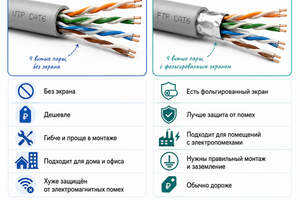
UTP (Unshielded Twisted Pair) — unshielded twisted pair. The conductors are protected only by their own plastic sheath.
FTP (Foiled Twisted Pair) — shielded twisted pair. It features an overall protective foil shield under the outer jacket to guard against external electromagnetic interference.
When to choose UTP:
- the cable is routed entirely indoors;
- there are no 220V/380V power lines nearby in the cable trays or walls;
- a small home or office system with a few cameras;
- standard operating conditions without industrial equipment nearby.
When FTP is recommended:
- the low-voltage cable runs parallel to power lines;
- installation is carried out in production facilities, warehouses, near electric motors or transformers;
- the line is routed outdoors (e.g., along a building facade or between poles) where there is a risk of induced impulse noise.
Important Expert Warning: An FTP cable's shield only works effectively if proper grounding is present! Installing such a line requires using special shielded connectors with a metal body and connecting them to grounded network equipment (switches or patch panels). Without grounding, the FTP cable's foil acts as an antenna, which will instead collect all radio interference, degrading signal quality.
Read more about this in the article what is the difference between UTP and FTP.
💡 Want to protect your signal from interference? Check out our range and choose a reliable FTP twisted pair cable for your facility.
Cat5e or Cat6 for video surveillance
The category determines the frequency bandwidth and the maximum data transmission speed in the network.
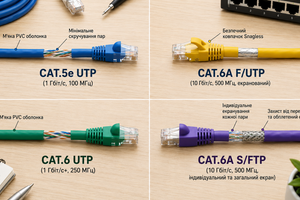
Cat5e provides speeds up to 1 Gbps at distances up to 100 meters. This is more than enough for most modern IP cameras (even with 4K or 8K resolution, which consume between 4 and 15 Mbps on average).
Cat6 supports speeds up to 10 Gbps. It features thicker copper conductors and an internal spline (separator), which minimizes internal crosstalk between pairs.
When Cat5e is sufficient:
- in standard residential, office, and commercial video surveillance systems;
- for connecting standard IP cameras (2 MP, 4 MP, 8 MP);
- if the budget for cable products is limited.
When it's worth investing in Cat6:
- at large facilities with hundreds of cameras where the routes converge into a single heavy backbone node;
- if future network upgrades to multi-gigabit speeds are planned;
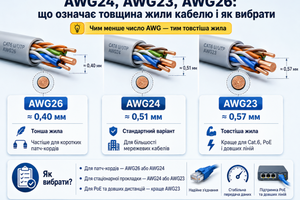
- to minimize voltage drop over maximum distances due to the larger wire gauge.
Learn more about the differences in the article what is the difference between Cat5e and Cat6.
Which cable to choose for PoE cameras
PoE (Power over Ethernet) technology allows transmitting power and digital data over a single twisted pair cable. Since current flows through thin conductors, strict requirements are placed on the physical properties of the wire.
The main rule for PoE — buy only 100% copper cable (Cu).
Cheap bimetallic cable (CCA — Copper Clad Aluminum) is often found on the market. Using it for PoE is strictly forbidden! Aluminum has significantly higher resistance than copper. Because of this, the cable will overheat, a critical voltage drop will occur, and cameras over long distances will constantly reboot or won't turn on at all.
For most PoE cameras, high-quality copper Cat5e cable is suitable. However, for high-power PTZ cameras with heavy IR illumination or heating, as well as for long cable runs, it is recommended to use high-quality copper FTP or Cat6 cable, where the wire gauge is larger, guaranteeing stable power transmission without loss.
🛒 Looking for a cable for uninterrupted camera operation with PoE? Go to our catalog and order pure copper twisted pair (Cu) with a quality guarantee.
How far can you run the cable
For standard Ethernet networks, the maximum recommended length of a single cable segment (from switch to camera) is 100 meters. This limitation applies to both Cat5e and Cat6 categories.
If the route length exceeds 100 meters, the following solutions are used to preserve the signal:
- intermediate PoE repeaters (extenders) or additional switches;
- specialized PoE switches with "Extend" mode (allowing cameras to be deployed up to 250 meters away by lowering the port speed to 10 Mbps, which is completely sufficient for a single camera's stream);
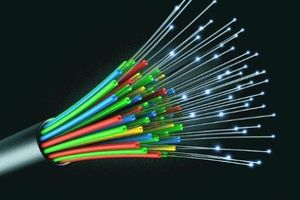
- fiber optic cable paired with media converters or SFP modules for backbones spanning hundreds of meters or kilometers.
To build large-scale video surveillance systems over vast territories, professionals always rely on high-quality SFP modules.
Outdoor video surveillance installation: choosing the right jacket
When choosing a cable for outdoor video surveillance, the key factor is not just the presence of a shield, but the material of its outer insulation:
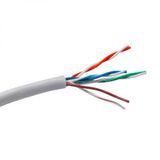
- PVC (Polyvinyl Chloride, usually grey) — intended exclusively for indoor use. Under the influence of outdoor ultraviolet rays and low temperatures, this jacket will crack in just 1–2 years, moisture will get inside, and the cable will fail.
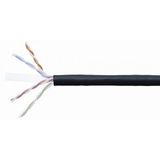
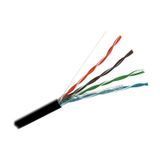
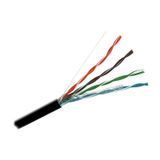
- PE (Polyethylene, usually black) — special cable for outdoor installation. It is resistant to solar radiation, moisture, severe frosts, and summer heat.
- LSZH (Low Smoke Zero Halogen) — fire-resistant cable without halogens, which does not emit toxic smoke when burning. Used indoors in public and residential areas with strict fire safety requirements.
What accessories are needed for installation
In addition to the cable itself, to properly configure and build a reliable video surveillance system, you will need:
- RJ45 connectors (for FTP cable, buy shielded metal connectors);
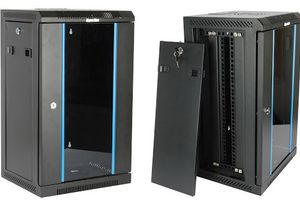
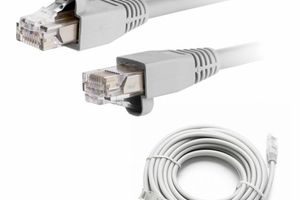
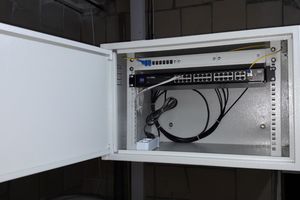
- patch cords for equipment patching in the server cabinet;
- RJ-45 internet outlets or Keystone RJ45 network modules;
- professional crimping tools (crimpers) and stripping tools for removing insulation.
To properly complete all connection steps yourself, we recommend checking out our step-by-step guide in the article how to crimp an RJ45 cable.
Common mistakes when choosing a cable
Saving money on small things when buying cable products can result in an unstable system that requires a complete overhaul in just a few months. Here are the main mistakes:
- Buying cheap bimetal (CCA) instead of copper for PoE lines — cameras will regularly disconnect or lose link due to power drops;
- Using indoor cable (PVC) outdoors — destruction of the jacket by sun and water will lead to a short circuit and burn out switch ports;
- Routing UTP directly next to power cables — electromagnetic induction from 220V lines will create severe video noise;
- Installing FTP without grounding — the lack of grounding turns the foil shield into a source of extra network noise;
- Skimping on connectors — poor crimping leads to contact oxidation and packet loss.
Frequently Asked Questions (FAQ)
What cable is needed for a digital IP camera?
For modern IP cameras, the best choice is a pure copper network twisted pair cable of Cat5e or Cat6 category.
Is Cat5e sufficient for 4K video surveillance?
Yes, perfectly sufficient. Cat5e bandwidth supports up to 1 Gbps, whereas even a 4K camera at maximum quality requires no more than 15-20 Mbps of data stream.
Which cable should I choose for outdoor video surveillance: FTP or UTP?
For outdoors, the main thing is to choose a cable with a black polyethylene (PE) jacket. If the cable runs next to power wires, go with FTP (with mandatory grounding); otherwise, outdoor UTP PE is suitable.
What is the maximum length of a twisted pair cable from a switch to a camera?
According to standards, the maximum length of an Ethernet segment is 100 meters. For longer distances, you will need repeaters, optical lines, or switches with a long-range mode (Extend).
Is it mandatory to buy copper cable for PoE cameras?
Yes, absolutely. Use only 100% copper (Cu). Copper-clad aluminum (CCA) cables have high resistance, which leads to voltage drops and severe cable heating.
Useful categories for quick navigation:
- Twisted pair cable
- Coaxial cable
- Patch cords
- RJ45 connectors
- RJ-45 internet outlets
- RJ45 network modules
- Crimping tools
Recommended expert articles:
- What is the difference between Cat5e and Cat6
- What is the difference between UTP and FTP
- How to crimp an RJ45 cable
- What is an SFP module and how to choose it
Conclusion
For most standard video surveillance systems, a 100% copper Cat5e UTP cable (for indoors) or Cat5e UTP PE (for outdoors) is the optimal choice in terms of price and quality. If the installation is done at industrial sites or near sources of heavy electromagnetic interference, you should opt for shielded FTP twisted pair with mandatory grounding of the equipment.
A properly selected cable will ensure stable camera operation without freezing, high video stream transmission speeds, and the longevity of the entire security system for years to come.